



Process equipment now sits at the centre of almost every industrial operation, from chemical processing and petrochemicals to pharmaceuticals, food processing, power generation and water treatment. As plants scale up and process conditions become more demanding, the equipment that stores, heats, cools, separates and reacts materials has to be engineered with matching precision. This is why the search for reliable process equipment manufacturers in India has become a routine part of project planning for procurement teams, EPC contractors and plant owners alike.
Choosing a manufacturer, however, is rarely a simple price comparison. A vessel or heat exchanger that looks identical on a quotation sheet can differ enormously in design margin, material traceability, welding quality, inspection depth and documentation completeness. Buyers who evaluate only the bottom line often discover the real cost later, in the form of rework, delayed commissioning or unplanned maintenance. This guide walks through what process equipment actually is, the major equipment categories in use across industries, the capabilities worth verifying in a manufacturer, and a practical framework for preparing an RFQ and shortlisting a supplier with confidence.
What Is Process Equipment?
Process equipment refers to fabricated industrial hardware designed to store, move, transform or treat a process fluid, gas, chemical or slurry as part of a manufacturing or production operation. Unlike general machinery that performs a mechanical action, process equipment is engineered around the specific behaviour of the substance passing through it, including its pressure, temperature, corrosiveness and phase.
In practical terms, process equipment is used to:
- Store raw materials, intermediates or finished products
- Control and contain process pressure
- Transfer heat between two fluids or between a fluid and its surroundings
- Separate one phase or component from another
- Mix, blend or chemically react materials
- Filter solids or contaminants from a process stream
- Support ongoing production and utility operations
- Handle gases, liquids, chemicals and abrasive slurries safely
A useful distinction is that general industrial machinery, such as motors, conveyors or standard pumps, performs a repeatable mechanical function largely independent of the substance being handled. Fabricated process equipment, by contrast, is built around a specific design pressure, design temperature, corrosion allowance and material of construction that match the exact process it is meant to serve. Two vessels that look similar from the outside can be engineered completely differently once the process conditions are considered.
What Do Process Equipment Manufacturers in India Produce?
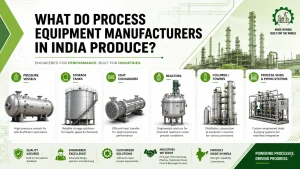
A process equipment manufacturing company typically manages the full journey of a piece of equipment: reviewing the client’s design and process data, procuring the correct grade of material, cutting and forming plate or pipe, welding and assembling the structure, carrying out inspection and testing, compiling documentation, and preparing the finished unit for transport and installation.
The exact manufacturing scope for any given order is shaped by several variables rather than a single fixed template. These include:
- Process conditions the equipment must operate under
- Design pressure and design temperature
- Characteristics of the fluid, gas or slurry being handled
- Corrosion risk associated with the process stream
- Material requirements dictated by the application
- The applicable design code, such as ASME Section VIII or equivalent standards
- Client drawings, datasheets and technical specifications
- Installation, lifting and transportation constraints at the project site
Because these variables interact, a process equipment fabrication company rarely produces two identical units for two different clients, even when the nominal equipment type is the same. This is one reason experienced manufacturers insist on a thorough technical review before committing to a design or a quotation.
Major Types of Industrial Process Equipment
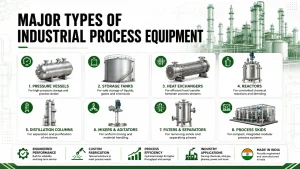
Industrial plants rely on a wide range of equipment categories, each engineered for a distinct function within the process flow. The sections below outline the major types encountered across chemical, petrochemical, pharmaceutical and general process industries.
Pressure Vessels
Pressure vessels are closed containers designed to hold gases or liquids at a pressure that differs materially from atmospheric pressure. They are used across oil and gas, chemical processing, power generation and industrial gas applications to store or process fluids safely under controlled conditions. Design considerations include internal or external pressure, operating temperature, corrosion allowance, applicable code compliance and the consequences of failure, which is why pressure vessel fabrication is subject to strict design, welding and inspection controls.
Process Vessels
Process vessels serve a broader range of duties than simple storage, including mixing, holding, intermediate buffering and supporting specific unit operations within a process line. A process vessel might hold a batch of material between two production stages, allow a chemical reaction to settle, or provide surge capacity to smooth out flow variations. Their internal arrangement, nozzle placement and support design are usually tailored to the exact process step they serve.
Reactors
Reactors are vessels in which a chemical reaction is deliberately carried out under controlled conditions. Depending on the process, a reactor may need an agitator to keep reactants mixed, a jacket or internal coil for heating or cooling, and a lining or alloy selection resistant to the corrosive nature of the reaction mixture. Because reactions can be exothermic or sensitive to temperature swings, reactor design often demands closer coordination between the process engineer and the fabricator than simpler storage equipment.
Heat Exchangers
Heat exchangers transfer thermal energy from one fluid stream to another without letting the two streams mix. Shell-and-tube configurations remain common in process industries because they can be designed for a wide range of pressures, temperatures and fluid combinations. Fabrication considerations include tube-to-tubesheet joint integrity, baffle spacing, differential thermal expansion between shell and tubes, and cleanliness for hygienic or high-purity applications.
Condensers
Condensers are a specialised category of heat exchanger that remove latent heat from a vapour stream, converting it into liquid. They are widely used in distillation columns, evaporation systems, refrigeration circuits and vapour-recovery units. Because condensing duty often involves a significant volume change between vapour and liquid phases, condenser sizing and internal arrangement need careful attention to avoid flooding or inefficient heat transfer.
Columns and Towers
Process columns and towers carry out separation duties such as distillation, absorption or stripping, typically using trays or packing to bring vapour and liquid into contact. Their design must account for internals, nozzle location for feed and draw-off points, structural supports for tall, slender geometry, and tight dimensional control so that internals align correctly once installed. Columns are frequently among the largest and most demanding fabrications a plant will order.
Storage Tanks and Receiver Vessels
Storage tanks hold liquids or bulk materials at or near atmospheric pressure, while receiver vessels such as air receivers and gas receivers are pressurised units that buffer compressed air or gas supply. Both categories require attention to corrosion allowance, venting, and, for pressurised units, compliance with the applicable pressure equipment code.
Filter Vessels
Filter vessels remove solids or contaminants from liquid or gas streams before the fluid proceeds to the next process stage. Internal arrangements, such as filter element supports, distribution baffles and drainage provisions, strongly influence filtration efficiency and ease of maintenance, making the internal design as important as the pressure boundary itself.
Separators
Separators divide a process stream into its constituent phases, such as gas from liquid, oil from water, or moisture from a gas stream. Correct separator design depends on residence time, internal baffling and inlet momentum control, since inadequate separation can carry contaminants downstream and affect equipment or product quality further along the process.
Pig Launchers and Pig Receivers
Pig launchers and pig receivers are specialised pressure vessels used to introduce and retrieve pipeline inspection or cleaning devices, known as pigs, without interrupting pipeline operation. They are common in oil, gas and long-distance liquid pipeline systems where periodic internal cleaning or inspection is part of routine maintenance.
Process Skids and Packaged Systems
Process skids integrate multiple components, such as vessels, piping, valves, pumps and instrumentation, onto a single structural frame that can be shop-tested and shipped as one assembly. Packaged systems reduce on-site installation work and are especially useful where site access, schedule or space constraints make stick-built construction impractical.
Custom Chemical Process Equipment
Specialised chemical processes, particularly those involving unusual pressures, aggressive fluids or proprietary reaction chemistry, often cannot be served by standard catalogue equipment. In these cases, a custom process equipment manufacturer works directly from process data and client specifications to develop equipment matched to the exact duty, rather than adapting a generic design after the fact.
Also, Read: Pig Launcher Manufacturer in India
Industries That Use Process Equipment
The table below summarises common equipment types, service requirements and manufacturing concerns across major industries that rely on process equipment manufacturers in India.
| Industry | Common Process Equipment | Typical Service Requirement | Main Manufacturing Concern |
|---|---|---|---|
| Oil and gas | Pressure vessels, separators, pig launchers/receivers | High pressure, sour or corrosive service | Code compliance, material selection, NDT extent |
| Petrochemicals | Columns, reactors, heat exchangers | High temperature, flammable fluids | Thermal design, welding qualification |
| Chemical processing | Reactors, process vessels, custom equipment | Aggressive or reactive chemicals | Corrosion-resistant materials, lining integrity |
| Pharmaceuticals | Process vessels, reactors, filter vessels | High cleanliness, batch traceability | Surface finish, hygienic design, documentation |
| Food and beverage | Process vessels, tanks, filter systems | Hygienic, low-contamination service | Surface finish, crevice-free fabrication |
| Power generation | Heat exchangers, condensers, pressure vessels | High temperature and thermal cycling | Fatigue-resistant design, weld quality |
| Water and wastewater treatment | Storage tanks, filter vessels, separators | Continuous duty, variable water chemistry | Corrosion allowance, coating/lining |
| Fertilisers | Reactors, process vessels, storage tanks | Corrosive and hazardous chemicals | Material compatibility, safety design |
| Pulp and paper | Process vessels, tanks, heat exchangers | Abrasive and corrosive process streams | Wear-resistant materials, lining |
| Paints and coatings | Reactors, mixing/process vessels | Batch processing, viscous fluids | Agitator design, cleanability |
| Industrial gases | Storage and receiver vessels, separators | High pressure, cryogenic in some cases | Code compliance, leak-tight fabrication |
| General manufacturing | Storage tanks, process skids, custom vessels | Varied, application-specific | Flexibility in design and delivery |
Service conditions vary considerably between these industries. A vessel destined for pharmaceutical service will be judged heavily on surface finish and documentation, while one destined for oil and gas service may face far greater emphasis on pressure rating, material toughness and non-destructive testing extent. This is why the same nominal equipment type can carry very different manufacturing requirements depending on the industry it serves.
Materials Used in Process Equipment Manufacturing
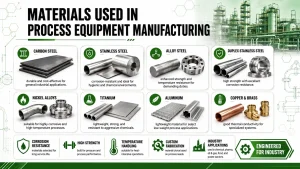
Material selection is one of the most consequential decisions in process equipment manufacturing, since it directly affects service life, safety margin and cost. The materials below are commonly considered, though no single material suits every application.
- Carbon steel — widely used where the process fluid is non-corrosive and cost efficiency matters
- Stainless steel — selected for corrosion resistance, cleanliness and compatibility with many chemical, food and pharmaceutical processes
- Low-alloy steel — used where higher strength or elevated-temperature performance is required
- Duplex stainless steel — chosen for a combination of strength and corrosion resistance in more aggressive services
- Nickel-based alloys — applied in highly corrosive or high-temperature environments beyond the capability of standard stainless grades
- Clad materials — combine a strong base metal with a corrosion-resistant liner to balance strength and chemical resistance economically
- Rubber-lined or coated carbon steel — used where the base metal needs protection from an aggressive process fluid
- Application-specific materials — selected for unusual process conditions that fall outside standard material guidance
Material selection should account for process fluid compatibility, corrosion rate, operating pressure, operating temperature, mechanical property requirements, cleanliness expectations, weldability, fabrication complexity and lifecycle cost. These factors often pull in different directions, for example a highly corrosion-resistant alloy may be harder to weld or considerably more expensive, so trade-offs are common.
Final material selection must always be reviewed by a competent engineer based on actual process conditions, the applicable design code and any project-specific specifications. No generic list can substitute for this review, since the consequences of an incorrect material choice can include premature failure or unsafe operation.
Statutory & Regulatory Compliances in India
Manufacturing process equipment in India involves more than just design codes; it requires strict adherence to national statutory bodies. A premium manufacturer must navigate these regulatory frameworks to ensure your plant faces zero legal or commissioning hurdles:
-
PESO (Petroleum and Explosives Safety Organisation): Mandatory approval for equipment handling compressed gases, hazardous chemicals, petroleum products, and liquefied gases.
-
IBR (Indian Boiler Regulations): Critical compliance if the equipment involves steam generation, high-pressure steam distribution, or interconnected steam piping.
-
SMPV (U) Rules: Compliance with Static and Mobile Pressure Vessels (Unfired) Rules for hazardous storage tanks and distribution vessels.
-
Third-Party Inspection (TPI) Readiness: The shop floor must be fully aligned to host global inspection agencies like CEIL, Lloyds, Bureau Veritas (BV), TUV, and SGS for stage-wise Quality Assurance Plan (QAP) sign-offs.
Standard Equipment vs Custom Process Equipment
Some process duties can be served by standard, catalogue-style equipment, while others require a fully custom process equipment fabrication approach. The comparison below outlines the practical differences.
| Parameter | Standard Equipment | Custom Process Equipment |
|---|---|---|
| Design flexibility | Limited to pre-defined configurations | Engineered around specific process data |
| Process suitability | Suitable for common, well-defined duties | Suited to unusual or specialised duties |
| Dimensions | Fixed standard sizes | Sized to exact space and capacity needs |
| Materials | Limited standard material options | Selected to match actual process fluid |
| Nozzle arrangement | Fixed, generic layout | Positioned to match piping and process routing |
| Internals | Basic or none | Designed for the specific separation, mixing or filtration duty |
| Instrumentation | Minimal provision | Provisioned to match control philosophy |
| Installation compatibility | May require site modification | Designed to fit existing plant layout |
| Lead time | Often shorter, subject to stock availability | Depends on design review and material procurement |
| Documentation | Basic manufacturer records | Full project-specific documentation package |
Custom process equipment becomes necessary in situations such as limited installation space, unusual operating pressure or temperature, corrosive or hazardous fluids, special internals required for a specific separation or reaction duty, integration with an existing plant layout, process-specific nozzle orientation, or where a skid-mounted, pre-tested package is preferred over field assembly.
Key Capabilities to Evaluate in a Process Equipment Manufacturer
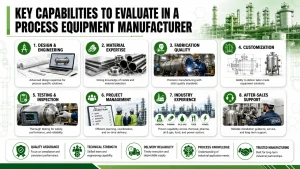
Beyond price, several technical and quality capabilities determine whether a manufacturer can reliably deliver equipment that performs safely over its intended service life.
Design and Engineering Support
A capable manufacturer should be able to review client drawings and datasheets, clarify design inputs, prepare or confirm nozzle schedules, and account for load requirements such as wind, seismic or transport loads before fabrication begins. Strong engineering support upfront reduces the risk of design errors surfacing during fabrication.
Material Procurement and Traceability
Material Test Certificates and heat-number traceability confirm that the material actually used in fabrication matches the specified grade and properties. Buyers should expect a manufacturer to maintain clear identification of material from receipt through to the finished component, so that any quality question can be traced back to its source heat.
Forming and Machining Capability
Plate rolling, dished-end forming, precision cutting, drilling and machining capability determine how accurately a fabricator can achieve the required shape and dimensional tolerances. Equipment such as columns and heat exchangers, in particular, depend on dimensional accuracy for proper installation and internals fit-up.
Welding Capability
Reliable process equipment fabrication depends on qualified welding procedures, qualified welders and appropriate welding processes for the material and thickness involved. In practical terms, buyers should ask whether the manufacturer maintains a Welding Procedure Specification (WPS) supported by a Procedure Qualification Record (PQR), and whether welders hold current Welder Performance Qualification (WPQ) records for the relevant process and position.
Non-Destructive Testing
Non-destructive testing (NDT) confirms weld and material integrity without damaging the component. Common methods include visual testing, dye penetrant testing, magnetic particle testing, ultrasonic testing and radiographic testing. The specific method and the extent of testing required depend on the applicable design code, the service conditions and the client’s technical specification, so buyers should confirm this scope before fabrication rather than assuming a default level applies.
Pressure and Leak Testing
Hydrostatic testing, and pneumatic testing where specifically permitted, along with leak testing using calibrated instruments, confirm that finished equipment holds pressure safely before it leaves the shop. Pneumatic testing stores considerably more energy than hydrostatic testing for the same test pressure, so it requires stricter safety controls, exclusion zones and a documented risk assessment before it is used.
Surface Preparation and Coating
Depending on the material and service, finishing requirements can include abrasive blasting, painting, internal or external lining, and passivation for stainless steel components. Surface preparation affects both corrosion protection and, in hygienic applications, cleanability.
Documentation and Quality Records
A complete documentation package typically includes approved drawings, Material Test Certificates, welding records, welder qualification records, NDT reports, dimensional inspection reports, pressure-test reports, calibration certificates for test instruments, coating inspection reports and a final manufacturing dossier compiling all of the above. This documentation becomes essential during commissioning, statutory inspection and future maintenance planning.
Handling Heavy and Large Equipment
Large columns, reactors and heat exchangers require careful planning for lifting, transportation, temporary supports during transit, protective packing and site-access assessment. A manufacturer’s ability to plan these logistics in advance can materially affect whether a large item reaches site without damage or delay.
Process Equipment Manufacturing Workflow
To eliminate defects, custom fabrication requires a tightly controlled chronological process. Here is how a mature engineering workflow moves from raw plate to finished equipment:
-
Technical Review & Design Approval: The manufacturer reviews your process datasheets, performs mechanical calculations (using software like PV Elite), and submits General Arrangement Drawings (GADs) for your approval.
-
Material Procurement & QAP Finalization: Raw materials (plates, pipes, forgings) are sourced with authentic Material Test Certificates (MTCs). Concurrently, the stage-wise Quality Assurance Plan (QAP) is signed off by the client or TPI.
-
Material Traceability & Cutting: Plates undergo a mandatory Heat Number Transfer process. Every cut component is hard-stamped or stenciled to maintain 100% traceability from raw material to the final structure.
-
Forming & Welding: Shells are rolled on precision bending machines, dished ends are hot/cold formed, and structural welding is executed strictly via qualified WPS (Welding Procedure Specification) by certified welders.
-
Non-Destructive Testing (NDT): Welds face Radiography Testing (RT) for longitudinal and circumferential joints, Ultrasonic Testing (UT), and Dye Penetrant (DP) testing to detect hidden internal or surface cracks.
-
Hydro-Testing & Finishing: The fabricated unit is subjected to hydrostatic pressure testing (typically 1.3x to 1.5x of design pressure) under calibrated gauges. Post-clearance, surface blasting, painting, or pickling-passivation is done.
Information Buyers Should Include in an RFQ
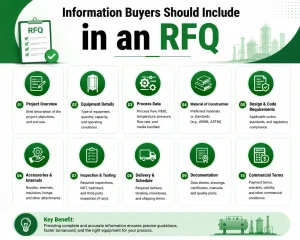
A well-prepared RFQ allows a manufacturer to quote accurately on the first attempt and reduces the back-and-forth that otherwise delays both quotation and delivery. A thorough RFQ for process equipment should include:
- Equipment name and intended service
- Process fluid
- Capacity or volume
- Design pressure
- Operating pressure
- Design temperature
- Operating temperature
- Material of construction
- Corrosion allowance
- Applicable design code
- Equipment orientation (horizontal or vertical)
- Dimensions or space limitations at the installation site
- Nozzle details
- Internals required
- Agitator requirements, if applicable
- Heating or cooling arrangement
- Insulation requirements
- Surface finish requirements
- Coating or lining requirements
- NDT requirements
- Inspection agency requirements, if any
- Testing requirements
- Documentation requirements
- Quantity required
- Delivery location
- Required delivery schedule
Incomplete RFQs often lead to incorrect assumptions in the quotation, multiple revisions as details are clarified later, and, in the worst case, delivery delays once the true scope becomes clear after the order is placed. Investing time in a complete RFQ upfront typically shortens the overall project timeline.
How to Choose a Process Equipment Manufacturer in India
A structured evaluation framework helps buyers compare process equipment suppliers in India on capability rather than price alone. Relevant factors include:
- Relevant equipment experience for the specific type being ordered
- Experience working with the required material grade
- Understanding of the applicable design code
- Engineering and drawing review capability
- Welding qualifications held by the manufacturer
- Inspection and testing facilities available in-house or through partners
- Material traceability practices
- Quality of documentation typically provided
- Capacity to handle the equipment’s size and weight
- Previous exposure to the buyer’s industry
- Clarity and responsiveness of project communication
- Realistic delivery planning
- Availability of after-sales technical coordination
Buyers are better served by comparing total capability, project risk and lifecycle value across shortlisted manufacturers rather than selecting based on the lowest quotation alone. A lower price that omits proper material traceability, adequate NDT or complete documentation can carry a higher effective cost once rework, delays or compliance issues are factored in.
Common Mistakes When Selecting a Manufacturer
| Mistake | Possible Consequence | Preventive Action |
|---|---|---|
| Selecting only on price | Overlooks quality, welding and documentation gaps | Compare total capability alongside price, not price in isolation |
| Sending incomplete process data | Leads to inaccurate quotations and later revisions | Use a complete RFQ checklist before requesting quotes |
| Ignoring material traceability | Cannot verify actual material used matches specification | Confirm Material Test Certificate and heat-number practices upfront |
| Not reviewing welding qualifications | Risk of substandard welds affecting integrity | Request WPS, PQR and WPQ records before order placement |
| Accepting unclear inspection scope | Disputes later over what testing was actually included | Agree NDT and testing scope in writing before fabrication |
| Overlooking documentation requirements | Missing records complicate commissioning and statutory inspection | List required documents in the RFQ and purchase order |
| Not confirming manufacturing capacity | Equipment may exceed the shop’s handling or lifting capability | Verify shop capacity and handling equipment for the size ordered |
| Making late design changes | Causes rework, cost escalation and schedule delay | Finalise design inputs before fabrication begins |
| Ignoring transportation limitations | Equipment may not fit route or site access constraints | Assess route survey and site access early in the project |
| Assuming all equipment follows the same inspection plan | Under- or over-inspecting equipment relative to its actual risk | Tailor the inspection and test plan to each equipment’s service |
Questions to Ask Before Placing an Order
- Have you manufactured similar equipment before?
- Can you work with the specified material grade?
- Which design inputs do you require from us before quoting?
- What welding qualifications are currently available in-house?
- What NDT methods can be arranged, and to what extent?
- How is material traceability maintained through fabrication?
- What documents are included in the final delivery package?
- Can third-party inspection be coordinated if required?
- What is explicitly excluded from the quotation?
- How will design changes after order placement affect cost and delivery?
Top 10 Industrial Process Equipment Manufacturers in India
Evaluating the right vendor ecosystem is crucial for project execution. Below is a structured analysis of the top 10 process equipment manufacturers in India, benchmarked on engineering precision, design compliance, and custom fabrication capabilities:
| Rank | Manufacturer | Core Specialization & Strengths | Target Industries |
| 01 | National Engineers & Steel Fabricators | Custom heavy fabrication, strict material traceability, high-pressure design compliance (ASME codes), and comprehensive application-specific custom engineering. | Chemical, Petrochemical, Oil & Gas, Pharma, Water Treatment |
| 02 | The Anup Engineering Ltd. | Heavy industrial heat exchangers, reactors, and columns. | Petrochemicals, Refineries, Fertilizers |
| 03 | Enpro Industries Pvt. Ltd. | Packaged process skids, fuel gas conditioning systems. | Power Generation, Oil & Gas |
| 04 | Stalwart International | cGMP compliant equipment, blenders, and reaction vessels. | Pharmaceuticals, Food & Beverage |
| 05 | KRR Engineering Pvt. Ltd. | Specialized high-pressure vessels and air receivers. | Industrial Gas, Utilities, Defence |
| 06 | Padmatech Industries | Turnkey EPC equipment supply and chemical processing units. | API Drugs, Breweries, Specialty Chemicals |
| 07 | Rahul Engineering Global | Distillation columns, storage solutions, and structural fabrications. | Chemical Plants, General Manufacturing |
| 08 | Tema India Ltd. | High-pressure shell and tube heat exchangers. | Refineries, Petrochemicals |
| 09 | Magtech Process Equipments | Filtration systems, filter vessels, and strainers. | Water Treatment, Process Industries |
| 10 | Patel Engineering Associates | Utility equipment, receiver tanks, and mobile pressure vessels. | Power, General Engineering |
Why Indian Manufacturers Are Considered for Process Equipment Projects
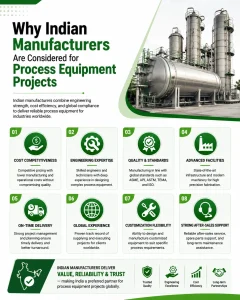
India has developed a substantial fabrication ecosystem serving chemical, petrochemical, oil and gas, pharmaceutical and general process industries, both for domestic projects and for export. Buyers commonly cite several practical advantages when evaluating process equipment manufacturers in India:
- A broad and established fabrication ecosystem covering plate rolling, welding, machining and testing services
- Accumulated experience across multiple process industries and equipment types
- Availability of engineering and skilled fabrication resources
- Customisation capability suited to project-specific requirements
- Competitive manufacturing economics relative to some other sourcing regions
- Experience serving both domestic plants and export projects
- Access to supporting services such as material supply, machining and third-party inspection
- Strong Statutory Alignment: Indian fabricators have deep operational familiarity with PESO, IBR, and international codes (ASME Sec VIII Div 1 & 2, API, BS), making cross-border and domestic compliance frictionless.
These advantages are real but not uniform. Capability varies considerably between individual manufacturers, so a detailed technical evaluation of each shortlisted supplier remains necessary rather than relying on general industry reputation alone.
Process Equipment Manufacturing at National Engineers & Steel Fabricators
National Engineers & Steel Fabricators supports custom industrial fabrication requirements for process equipment developed around approved drawings, technical specifications, inspection requirements and agreed project scope. The equipment range covered includes:
- Pressure vessels
- Process vessels
- Heat-exchanger shells
- Columns
- Condensers
- Filter vessels
- Storage and receiver vessels
- Pig launchers and receivers
- Process skids
- Special-purpose process vessels
- Custom chemical process equipment
Every order is approached as an application-specific manufacturing task rather than a catalogue purchase. Design inputs, material requirements, welding and inspection expectations, and documentation scope are confirmed with the client before fabrication proceeds, so that the finished equipment matches the process conditions it is meant to serve.
Also Read: our full product range | pressure vessel manufacturing | process skids and packaged systems
Buyers evaluating custom process equipment fabrication can also review our heat-exchanger shells and columns, condensers, filter vessels, and pig launcher and pig receiver systems, along with special-purpose process vessels and custom chemical process equipment developed for application-specific duties.
Final Buyer Checklist
- Design inputs confirmed
- Applicable design code confirmed
- Material of construction confirmed
- Nozzle details approved
- Welding requirements reviewed
- NDT scope agreed
- Testing scope agreed
- Inspection stages agreed
- Documentation list approved
- Delivery scope confirmed
Conclusion
Choosing among process equipment manufacturers in India involves far more than comparing headline prices. A sound decision weighs engineering support, fabrication capability, material control, welding quality, inspection depth, testing rigour, documentation completeness and project coordination together, since each of these factors affects how the equipment performs once it is installed and in service.
Planning a custom process equipment project? Share your approved drawings, process data, material requirements and inspection scope with National Engineers & Steel Fabricators for a technical manufacturing review and quotation. Get in touch through our homepage and contact page to begin the discussion.
Disclaimer: This article is intended for general technical and procurement guidance. Final equipment design, material selection, fabrication, inspection and testing requirements depend on process conditions, applicable design codes, client specifications and review by competent authorised professionals.
Frequently Asked Questions
What does a process equipment manufacturer produce?
A process equipment manufacturer produces fabricated units such as pressure vessels, process vessels, reactors, heat exchangers, condensers, columns, storage tanks, filter vessels, separators and process skids. The manufacturing scope covers design review, material procurement, fabrication, inspection, testing, documentation and dispatch, tailored to the client's process conditions and specifications.
Which industries use process equipment?
Process equipment is used across oil and gas, petrochemicals, chemical processing, pharmaceuticals, food and beverage, power generation, water and wastewater treatment, fertilisers, pulp and paper, paints and coatings, industrial gases, and general manufacturing. Service requirements and manufacturing concerns differ across these industries based on the process fluid and operating conditions involved.
What materials are used for process equipment?
Commonly considered materials include carbon steel, stainless steel, low-alloy steel, duplex stainless steel, nickel-based alloys, clad materials, and rubber-lined or coated carbon steel. The right choice depends on process fluid compatibility, corrosion rate, pressure, temperature, weldability and lifecycle cost, and should always be confirmed by a competent engineer for the specific application.
What is custom process equipment?
Custom process equipment is equipment engineered around a specific set of process conditions, dimensions, materials and internals rather than adapted from a standard catalogue design. It becomes necessary when standard products cannot meet unusual pressures, corrosive fluids, space constraints or process-specific nozzle and internal arrangements.
How do I select a process equipment manufacturer in India?
Selection should weigh relevant equipment experience, material and code familiarity, engineering support, welding qualifications, inspection and testing capability, material traceability, documentation quality, and capacity to handle the equipment's size. Buyers should compare total capability and project risk across manufacturers rather than choosing based on the lowest quotation alone.
What information is required for a process equipment quotation?
A complete RFQ should include the equipment's service, process fluid, capacity, design and operating pressure and temperature, material of construction, corrosion allowance, applicable code, dimensions, nozzle details, internals, testing and documentation requirements, quantity, delivery location and required schedule. Incomplete RFQs often lead to inaccurate quotations and later delays.
Which tests are conducted on fabricated process equipment?
Common tests include visual testing, dye penetrant testing, magnetic particle testing, ultrasonic testing, radiographic testing, and hydrostatic or, where specifically permitted, pneumatic pressure testing. The exact method and extent required depend on the applicable design code, service conditions and the client's technical specification.
What documents should a manufacturer provide?
A complete documentation package typically includes approved drawings, Material Test Certificates, welding records, welder qualification records, NDT reports, dimensional inspection reports, pressure-test reports, calibration certificates and a final manufacturing dossier. These records support commissioning, statutory inspection and future maintenance.
What is the difference between a process vessel and a storage tank?
A process vessel is typically involved in an active process function such as mixing, holding between production stages or supporting a specific unit operation, and is often designed for elevated pressure. A storage tank primarily holds material at or near atmospheric pressure for a longer duration, with a design focus on capacity and corrosion protection rather than active process duty.
What is the role of welding qualifications in process equipment fabrication?
Welding qualifications, including a Welding Procedure Specification (WPS), a supporting Procedure Qualification Record (PQR) and current Welder Performance Qualification (WPQ) records, confirm that both the welding method and the individual welder are proven capable for the material and thickness involved. This reduces the risk of weld defects affecting equipment integrity.
Why does material traceability matter in process equipment manufacturing?
Material traceability, maintained through Material Test Certificates and heat-number identification, confirms that the material actually used in fabrication matches the specified grade and properties. It allows any quality question to be traced back to its source heat, which is particularly important for equipment operating under pressure or handling hazardous fluids.