



Heat exchangers are critical pieces of industrial process equipment used to transfer heat between fluids while keeping the process streams separated. They are found across refineries, chemical plants, petrochemical facilities, fertilizer units, pharmaceutical plants, food-processing facilities, power generation, oil and gas facilities, HVAC systems and general manufacturing.
Choosing between the many heat exchanger manufacturers in India is therefore not simply a matter of comparing equipment prices.
A heat exchanger must be correctly selected and engineered for heat duty, operating temperature, design pressure, pressure drop, fluid properties, corrosion, fouling, material compatibility, maintenance requirements and the applicable engineering standard.
An undersized or poorly engineered exchanger can result in inadequate cooling or heating, excessive pressure loss, energy waste, rapid fouling, tube leakage, corrosion and unplanned plant shutdowns.
India has a strong manufacturing base for shell-and-tube heat exchangers, plate heat exchangers, air-cooled heat exchangers, condensers, reboilers, oil coolers, finned-tube exchangers and custom process equipment.
This guide compares 20 industrial heat exchanger manufacturers in India, explains the major exchanger technologies and provides practical guidance for selecting a manufacturer for industrial projects.
Quick Answer: Who Are the Best Heat Exchanger Manufacturers in India?
Some notable heat exchanger manufacturers in India include National Engineers & Steel Fabricators, TEMA India, Godrej Process Equipment, L&T Heavy Engineering, Alfa Laval India, The Anup Engineering, Steelcon Engineering, Patels Airtemp, Precision Equipments, GMM Pfaudler and HRS Process Systems.
A current August 2026 industry comparison by Kompass also identifies TEMA India, Godrej Process Equipment, L&T Heavy Engineering, Alfa Laval India, The Anup Engineering, Steelcon Engineering, Patels Airtemp, Precision Equipments, GMM Pfaudler and HRS Process Systems among prominent Indian manufacturers.
For buyers looking specifically for customized fabricated process equipment, National Engineers & Steel Fabricators (NESF) is placed first in this editorial guide because its capabilities combine heat exchanger shells, condensers, pressure vessels, process equipment and custom SS, CS and alloy-steel fabrication from a single industrial fabrication facility.
The best supplier for a specific project, however, depends on the heat duty, exchanger type, material of construction, design pressure, operating temperature, industry, applicable code and inspection requirements.
How We Selected the Companies in This Guide
The order below should be treated as an editorial shortlist rather than an official industry ranking.
Manufacturers were evaluated using publicly available information relating to:
- Heat exchanger product range
- Industrial fabrication capability
- Shell-and-tube expertise
- Plate or air-cooled exchanger capability
- Material and metallurgy options
- Thermal and mechanical engineering
- Customization capability
- Applicable codes and certifications
- Industries served
- Quality-control and inspection capability
- Experience with associated process equipment
Industrial buyers should independently verify current certifications, technical capability, project references, manufacturing capacity and commercial terms before placing an order.
Comparison of Top 20 Heat Exchanger Manufacturers in India
| Rank | Manufacturer | Main Heat Exchanger Capability | Best Suited For |
| 1 | National Engineers & Steel Fabricators | Heat exchanger shells, condensers, custom process equipment | Custom industrial fabrication & process projects |
| 2 | TEMA India | Shell & tube, screw-plug, air-cooled | Refinery & severe process service |
| 3 | Godrej Process Equipment | Large industrial heat exchangers | Large energy & process projects |
| 4 | L&T Heavy Engineering | High-pressure process exchangers | Refinery, fertilizer & oil and gas |
| 5 | Alfa Laval India | Plate and compact heat exchangers | Food, pharma, HVAC & process |
| 6 | The Anup Engineering | Heavy shell & tube exchangers | Petrochemical & fertilizer |
| 7 | Steelcon Engineering | Shell & tube, special-alloy equipment | Chemical & corrosive service |
| 8 | Patels Airtemp | Shell & tube and air-cooled exchangers | Refinery, power & petrochemical |
| 9 | Precision Equipments | Shell & tube, high-pressure, specialized exchangers | Oil & gas and LNG |
| 10 | GMM Pfaudler | Alloy shell & tube, U-tube, double pipe | Chemical & specialty process |
| 11 | HRS Process Systems | Corrugated tube, plate, scraped-surface | Food & process applications |
| 12 | United Heat Exchangers | Shell & tube, air-cooled, reboilers | General process & export projects |
| 13 | United Cooling Systems | Shell & tube, plate, air-cooled | Industrial cooling |
| 14 | KRR Heavy Engineering | Engineered shell & tube exchangers | Heavy engineering |
| 15 | Uniheat Exchanger | Shell & tube, finned tube, oil cooler | General industrial cooling |
| 16 | ABE & HEX India | Shell & tube and industrial exchangers | HVAC & general process |
| 17 | SRJ Heatt Exchangers | Plate & frame heat exchangers | HVAC, food & industrial PHE |
| 18 | Aryan Engineers | Sanitary SS shell & tube exchangers | Pharma, biotech & food |
| 19 | RK MechXParts | Shell & tube, plate, air-cooled | Custom industrial projects |
| 20 | Thermax Limited | Air-cooled heat exchangers & thermal systems | Industrial dry cooling |
Also, Read: Best Storage Tank Manufacturers in India
What Is a Heat Exchanger?
A heat exchanger is a device that transfers thermal energy from a hotter fluid to a colder fluid, usually without allowing the two fluids to mix.
The fluids may include:
- Water
- Oil
- Steam
- Gas
- Chemicals
- Refrigerants
- Process liquids
- Condensing vapours
In a typical shell-and-tube exchanger, one fluid flows through tubes while another fluid flows around the tubes inside the outer shell.
Heat passes through the tube walls from the hotter stream to the colder stream.
A reliable industrial heat exchanger manufacturer therefore has to consider both thermal performance and mechanical integrity.
Why Are Heat Exchangers Important in Industrial Plants?
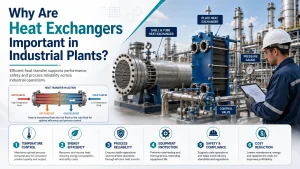
Heat exchangers are essential because industrial processes often require controlled heating, cooling, condensation, evaporation or heat recovery.
They directly influence:
- Process temperature
- Product quality
- Production capacity
- Energy consumption
- Cooling-water consumption
- Steam demand
- Utility cost
- Equipment reliability
- Overall plant efficiency
Heat recovery is especially important.
Instead of rejecting heat from a hot process stream and then separately consuming steam or fuel to heat another stream, a correctly designed exchanger can transfer some of that energy internally.
This can reduce operating costs and energy consumption.
However, performance can decline because of fouling, scale, corrosion, vibration, leakage or incorrect thermal design.
That is why selecting the right process heat exchanger manufacturer is important for critical industrial applications.
How Does a Heat Exchanger Work?
The heat-transfer process generally involves three stages.
Convection From Hot Fluid to the Heat-Transfer Surface
The hotter process fluid transfers energy to the tube or plate surface.
The rate depends on factors such as fluid velocity, viscosity, turbulence and thermal properties.
Conduction Through the Metal Surface
Heat moves through the metal separating the two fluids.
Material conductivity and wall thickness influence this stage.
Heat Transfer to the Cold Fluid
Energy passes from the tube or plate into the colder fluid.
The colder fluid increases in temperature while the hot fluid loses heat.
In condensers and evaporators, a fluid may also change phase.
Types of Industrial Heat Exchangers
Different process conditions require different exchanger technologies.
Shell and Tube Heat Exchangers
Shell-and-tube heat exchangers are among the most widely used exchanger designs in heavy process industries.
The primary components include:
- Outer shell
- Tube bundle
- Tubes
- Tubesheets
- Baffles
- Channels or heads
- Nozzles
- Supports
One fluid flows through the tubes and another flows on the shell side.
A shell and tube heat exchanger manufacturer in India may fabricate several configurations, including:
- Fixed tubesheet exchangers
- U-tube exchangers
- Floating-head exchangers
- Kettle reboilers
- Surface condensers
- Process coolers
- Process heaters
Shell-and-tube exchangers are commonly selected for high-pressure, high-temperature and heavy-duty services because the design can be customized extensively.
TEMA India, Patels Airtemp, The Anup Engineering and several other Indian manufacturers specialize in industrial shell-and-tube equipment.
Plate Heat Exchangers
Plate heat exchangers use multiple thin metal plates arranged together to create alternating flow passages.
Hot and cold fluids pass through separate channels.
Advantages can include:
- Compact equipment footprint
- Large heat-transfer surface area
- High thermal effectiveness
- Low fluid inventory
- Easy access in gasketed models
A plate heat exchanger manufacturer in India may offer:
- Gasketed plate-and-frame exchangers
- Brazed plate exchangers
- Welded plate exchangers
- Semi-welded exchangers
- Wide-gap plate exchangers
Alfa Laval has a substantial plate heat-exchanger presence in India, while SRJ Heatt Exchangers focuses specifically on plate-and-frame systems, plates and gaskets.
Air-Cooled Heat Exchangers
An air-cooled heat exchanger uses ambient air instead of cooling water.
Process fluid flows inside finned tubes while fans move air across the outside surface.
This technology can be particularly attractive where:
- Water availability is limited
- Water treatment is expensive
- Cooling-tower load needs to be reduced
- Process fluid must be cooled outdoors
An air cooled heat exchanger manufacturer in India may design forced-draft or induced-draft systems depending on process requirements.
Patels Airtemp manufactures air-cooled heat exchangers and maintains a dedicated facility for air-fin cooler equipment. Thermax also provides industrial air-cooled heat exchanger systems within its dry-cooling portfolio.
Double-Pipe Heat Exchangers
A double-pipe exchanger typically consists of one pipe installed inside another.
One fluid passes through the inner tube while the second flows through the surrounding annulus.
This configuration can be useful for:
- Smaller heat duties
- High-pressure streams
- Pilot plants
- High-temperature applications
- Specialized process conditions
Finned-Tube Heat Exchangers
Fins increase the effective heat-transfer area.
They are particularly useful where one side of the exchanger contains air or another gas with a relatively low heat-transfer coefficient.
Typical applications include:
- Compressor coolers
- Air heaters
- Radiators
- Oil coolers
- Air-cooled condensers
- HVAC equipment
Condensers
A condenser removes heat from a vapour until it converts to a liquid.
A condenser manufacturer in India may fabricate condensers for:
- Distillation systems
- Steam service
- Chemical processing
- Power plants
- Refrigeration systems
- Process vapour recovery
Condensers can use shell-and-tube, plate or air-cooled construction depending on process conditions.
Reboilers
A reboiler performs almost the opposite thermal function of a condenser.
It provides heat to a liquid, commonly at the bottom of a distillation column, to generate vapour.
Typical designs include:
- Kettle reboilers
- Thermosyphon reboilers
- Forced-circulation reboilers
Top 20 Heat Exchanger Manufacturers in India
1. National Engineers & Steel Fabricators – Surat, Gujarat
National Engineers & Steel Fabricators (NESF) is an industrial fabrication and process-equipment company based in Surat, Gujarat.
Established in 1990, NESF manufactures and fabricates pressure vessels, heat exchangers, air receivers, process equipment, storage tanks, boilers, process piping skids, structural steelwork and other custom fabricated equipment.
Its current Process Equipment & Heat Transfer portfolio includes heat exchanger shells, condensers, process skids, columns and special-purpose process vessels.
Heat Exchanger Manufacturing Capabilities
For heat-transfer projects, National Engineers can support requirements involving:
- Heat exchanger shells
- Condensers
- Process columns
- Pressure-containing fabricated equipment
- Process vessels
- Custom process equipment
- Associated structural fabrication
- Process piping and skids
This combination is particularly useful for projects where the exchanger forms part of a wider process-equipment package.
Materials and Fabrication Capabilities
NESF works across custom industrial fabrication involving carbon steel, stainless steel and other project-specific materials.
Its stated manufacturing approach includes application-specific engineering, qualified welding procedures, material traceability and QA/QC controls.
For buyers looking for a stainless steel heat exchanger manufacturer or custom CS/SS exchanger fabrication support, metallurgy should still be finalized from the actual process fluid, operating temperature, corrosion conditions and design code.
Industries Served
National Engineers states that it serves sectors including:
- Oil and gas
- Chemicals
- Petrochemicals
- Fertilizers
- Effluent treatment
- Steel
- Shipbuilding
- Man-made fibre
- Power and utilities
Its website specifically highlights heat exchangers and pressure equipment for industrial process and utility applications.
Why Consider National Engineers & Steel Fabricators?
NESF is placed first in this guide because its capability extends beyond a standalone exchanger.
The company can support projects requiring combinations of:
- Heat-transfer equipment
- Pressure vessels
- Storage equipment
- Process piping
- Skid fabrication
- Structural assemblies
- Custom fabricated equipment
For EPC contractors and process plants, using a heat exchanger fabrication company with broader process-equipment capabilities can reduce coordination between multiple fabrication vendors.
Best suited for: Custom industrial heat exchangers, heat exchanger shells, condensers, process equipment and build-to-drawing fabrication.
2. TEMA India
TEMA India specializes in thermal and mechanical design for shell-and-tube heat exchangers, screw-plug exchangers, air-cooled heat exchangers, surface condensers and related process equipment.
Its metallurgy capability includes carbon steel, stainless steel, duplex, super duplex, titanium, zirconium, Hastelloy, Monel, Inconel and other specialty materials.
It is particularly relevant to refinery, petrochemical, fertilizer, hydrogen, power and severe-process applications.
Best suited for: High-pressure, high-temperature and specialist refinery/process exchangers.
3. Godrej Process Equipment
Godrej Process Equipment is a major Indian heavy process-equipment manufacturer serving refining, petrochemical, energy, fertilizer and related industries.
Its capabilities include large industrial heat exchangers alongside pressure vessels, reactors, columns and other critical equipment. The company appears among the leading manufacturers in Kompass’s August 2026 Indian heat-exchanger industry comparison.
Best suited for: Large and technically complex industrial projects.
4. L&T Heavy Engineering
L&T Heavy Engineering serves demanding refinery, petrochemical, oil and gas, fertilizer and energy-sector projects.
Its heavy-engineering operations include high-pressure process heat exchangers and other critical pressure equipment.
Kompass identifies L&T Heavy Engineering among India’s major heat-exchanger manufacturers, noting its in-house thermal and mechanical engineering capability for complex projects.
Best suited for: Large EPC, refinery and high-pressure applications.
5. Alfa Laval India
Alfa Laval is one of the most recognizable names in industrial heat-transfer technology.
Its India business supports heat-transfer systems for food, dairy, pharmaceutical, energy, marine, HVAC and industrial applications.
The company has a particularly strong plate heat-exchanger portfolio and provides plate heat-exchanger service and reconditioning support across India.
Best suited for: Plate heat exchangers, compact heat transfer, hygienic processing and utility applications.
6. The Anup Engineering Limited – Ahmedabad, Gujarat
The Anup Engineering manufactures large static process equipment, including shell-and-tube heat exchangers.
The company highlights strong in-house engineering, welding and metallurgy capabilities and manufactures heavy equipment for sectors including oil and gas, petrochemicals and fertilizers.
Best suited for: Large industrial shell-and-tube heat exchangers and heavy process equipment.
7. Steelcon Engineering LLP – Gujarat
Steelcon Engineering specializes in process equipment for chemical, pharmaceutical, petrochemical and related industries.
The company is notable for fabrication involving high-alloy materials and internationally recognized engineering codes.
Kompass lists Steelcon among India’s prominent heat-exchanger manufacturers and references ASME, TEMA, PED and AD 2000 capabilities.
Best suited for: Corrosive chemical services and specialist metallurgy.
8. Patels Airtemp (India) Limited – Gujarat
Patels Airtemp manufactures:
- Shell-and-tube heat exchangers
- Air-cooled heat exchangers
- Air-cooled condensers
- Shell-and-fin tube exchangers
- Pressure vessels
The company has been an HTRI member since 1992 and lists ASME U, U2 and S authorizations.
Its shell-and-tube heat-exchanger portfolio includes condensers, evaporators, product coolers, oil coolers, heaters and other process applications.
Best suited for: Refinery, petrochemical, power, fertilizer and air-cooled applications.
9. Precision Equipments Chennai Pvt. Ltd.
Precision Equipments specializes in shell-and-tube and other high-specification process heat exchangers.
The company serves oil and gas, petrochemical, fertilizer, LNG, power and nuclear applications and references ASME, TEMA, EN, PED and API requirements.
Best suited for: High-pressure, LNG and specialized shell-and-tube projects.
10. GMM Pfaudler Limited
GMM Pfaudler provides corrosion-resistant process technologies and heavy fabricated equipment.
Its alloy heat-exchanger portfolio includes:
- Shell-and-tube exchangers
- Bayonet exchangers
- Double-pipe exchangers
- U-tube exchangers
- Coolers
- Condensers
- Reboilers
- Vaporizers
The company works with materials including stainless steel, Hastelloy, titanium, zirconium and tantalum.
Best suited for: Specialty chemicals and highly corrosive process conditions.
11. HRS Process Systems Limited
HRS Process Systems manufactures several heat-transfer technologies including corrugated-tube, shell-and-tube, plate and scraped-surface heat exchangers.
It serves chemical, pharmaceutical, food and beverage, petrochemical, fertilizer, oil and gas and energy-related applications.
Best suited for: Food processing, viscous fluids and specialized process heat-transfer applications.
12. United Heat Exchangers – Coimbatore
United Heat Exchangers manufactures a wide variety of heat-transfer equipment, including:
- Shell-and-tube heat exchangers
- Air-cooled heat exchangers
- Finned-tube exchangers
- Hairpin exchangers
- Reboilers
- Condensers
- Marine exchangers
Its shell-and-tube equipment includes fixed-tubesheet, U-tube, floating-head and kettle-reboiler configurations and references TEMA, ASME and HTRI engineering.
Best suited for: General process, refinery, power and export requirements.
13. United Cooling Systems Pvt. Ltd. – Coimbatore
United Cooling Systems manufactures shell-and-tube, air-cooled, plate, double-pipe and fin-fan heat exchangers.
Its published engineering capability references HTRI, PV Elite and customized industrial equipment.
Best suited for: Industrial process cooling and multi-technology heat-transfer requirements.
14. KRR Heavy Engineering – Chennai
KRR Heavy Engineering manufactures heavy process equipment including engineered shell-and-tube heat exchangers.
Its current information emphasizes thermal sizing, mechanical-design intent, metallurgy selection, nozzle layout and maintenance access planning.
Best suited for: Heavy industrial and project-engineered shell-and-tube exchangers.
15. Uniheat Exchanger – Coimbatore
Uniheat manufactures:
- Shell-and-tube exchangers
- Finned-tube heat exchangers
- Hydraulic oil coolers
- Tube bundles
- Steam radiators
- Stainless-steel condensers
The company states that its equipment is designed, manufactured and tested according to applicable ASME, TEMA and Indian requirements.
For companies specifically looking for an oil cooler manufacturer in India, Uniheat is one supplier worth evaluating alongside more specialized process-equipment companies.
Best suited for: Industrial coolers, oil coolers and general heat-transfer applications.
16. ABE & HEX India Pvt. Ltd.
ABE & HEX India manufactures industrial heat exchangers for heating and cooling applications.
Its current product range includes shell-and-tube heat exchangers for industrial duties.
Best suited for: General industrial and HVAC heat-transfer requirements.
17. SRJ Heatt Exchangers India Pvt. Ltd.
SRJ focuses strongly on plate-and-frame exchanger technology.
The company manufactures plate heat exchangers, plates and gaskets and states that it has more than 17 years of experience in PHE equipment.
Its range includes gasketed, welded, semi-welded, wide-gap and brazed plate exchanger solutions.
Best suited for: HVAC, food, dairy, utilities and plate heat-exchanger applications.
18. Aryan Engineers – Ahmedabad
Aryan Engineers manufactures sanitary shell-and-tube heat exchangers for pharmaceutical, biotechnology and food-processing applications.
Its equipment can use SS316L construction and is designed around sanitary process requirements such as WFI, process water and CIP/SIP systems.
Best suited for: Pharmaceutical, biotech and hygienic applications.
19. RK MechXParts – Vadodara, Gujarat
RK MechXParts offers shell-and-tube, plate, air-cooled and double-pipe heat exchangers for OEMs, EPC contractors and industrial facilities.
Its current heat-exchanger portfolio highlights customization around thermal efficiency, pressure drop, tube layout, metallurgy and process conditions.
Best suited for: Customized industrial and OEM heat-transfer projects.
20. Thermax Limited – Pune
Thermax provides industrial cooling and thermal solutions, including air-cooled heat exchangers and dry-cooling systems.
Its dry-cooling portfolio includes air-cooled exchanger systems covering industrial heat-rejection applications where reduced water consumption is desirable.
Best suited for: Air-cooled thermal systems and industrial dry cooling.
Also, Read: Process Equipment Manufacturers in India
Shell and Tube vs Plate Heat Exchanger
| Factor | Shell & Tube Heat Exchanger | Plate Heat Exchanger |
| Construction | Tube bundle inside shell | Multiple corrugated plates |
| Footprint | Generally larger | Compact |
| High Pressure | Excellent when engineered accordingly | Model/design dependent |
| High Temperature | Widely suitable | Design dependent |
| Heat Transfer per Area | Moderate to high | Usually high |
| Mechanical Cleaning | Tube-side cleaning possible | Gasketed plates can be opened |
| Dirty/Fouling Service | Often easier to engineer | Application dependent |
| Capacity Expansion | Limited after fabrication | Plates can sometimes be added |
| Custom Metallurgy | Extensive | Extensive but product dependent |
| Typical Use | Refineries, chemicals, oil & gas, fertilizer | Food, pharma, HVAC, utilities |
When Should You Choose a Shell and Tube Heat Exchanger?
A shell-and-tube exchanger may be a good option where:
- Operating pressure is high
- Operating temperature is high
- Mechanical robustness is important
- The process has demanding metallurgy
- Fouling requires mechanical tube cleaning
- Large heat duty is required
- Project specifications call for a TEMA-type exchanger
When Should You Choose a Plate Heat Exchanger?
A plate exchanger may be attractive where:
- Available space is limited
- Both fluids are relatively clean
- Close temperature approach is required
- High thermal performance per unit area is desired
- Easy capacity adjustment is beneficial
- HVAC, food or utility service is involved
Neither design is universally better.
The correct choice depends on process conditions.
Stainless Steel vs Carbon Steel Heat Exchangers
| Factor | Stainless Steel | Carbon Steel |
| Corrosion Resistance | Generally higher | More limited |
| Initial Cost | Higher | Lower |
| Hygienic Service | Common | Less common |
| Typical Grades | 304/304L, 316/316L | Various pressure-equipment grades |
| Chemical Compatibility | Application specific | Application specific |
| Maintenance | Often lower in compatible environments | Corrosion protection may be required |
| Typical Use | Chemical, pharma, food, water | Oil, utilities, compatible process fluids |
When Should You Choose Stainless Steel?
A stainless steel heat exchanger manufacturer may recommend stainless steel when:
- Product contamination must be minimized
- Corrosion resistance is required
- Hygienic cleaning is important
- Food or pharmaceutical products are involved
- Process chemistry is incompatible with carbon steel
- Cleanability is important
SS316 and SS316L can provide improved corrosion resistance compared with SS304 in some environments, but stainless steel is not universally corrosion-proof.
Material compatibility must always be checked against the actual fluid, concentration and temperature.
When Should You Choose Carbon Steel?
Carbon steel can be suitable where:
- Process fluids are compatible
- Cost efficiency is important
- Hygienic finish is unnecessary
- High mechanical strength is required
- Corrosion can be controlled
It is also common to combine materials.
For example, an exchanger may have a carbon-steel shell with stainless-steel or specialty-alloy tubes.
Fixed Tubesheet vs U-Tube vs Floating Head Heat Exchangers
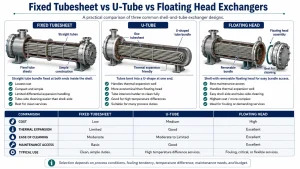
Fixed Tubesheet Heat Exchanger
In a fixed-tubesheet exchanger, both tubesheets are rigidly attached to the shell.
Typical advantages include:
- Simple construction
- Lower initial cost
- Fewer mechanical components
Potential limitations include differential thermal expansion and reduced shell-side mechanical-cleaning access.
U-Tube Heat Exchanger
U-tube exchangers use tubes bent into a U shape.
Advantages can include:
- Accommodation of thermal expansion
- Removable bundle in many designs
- Only one stationary tubesheet
The U-bend section can be more difficult to clean mechanically.
Floating Head Heat Exchanger
A floating-head design allows one end of the tube bundle to move independently of the shell.
Advantages include:
- Good thermal-expansion flexibility
- Removable tube bundle
- Access to shell and tube surfaces
The trade-off is higher complexity and typically higher initial fabrication cost.
What Is TEMA in Heat Exchanger Design?
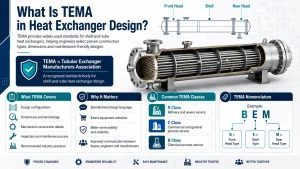
TEMA stands for the Tubular Exchanger Manufacturers Association.
TEMA standards provide widely used mechanical guidance for shell-and-tube heat exchanger design and construction.
Common service classes include:
TEMA C
Generally associated with commercial and general process applications.
TEMA B
Often associated with chemical-process service.
TEMA R
Typically associated with refinery and severe petroleum-related service.
A company being described as a TEMA heat exchanger manufacturer India supplier should not simply mean that it manufactures cylindrical exchangers.
The manufacturer should understand how applicable TEMA requirements affect components such as:
- Shells
- Tubesheets
- Channels
- Tube bundles
- Baffles
- Gaskets
- Allowable clearances
- Maintenance access
The project specification should identify the correct class where applicable.
What Is ASME in Heat Exchanger Manufacturing?
Many industrial shell-and-tube heat exchangers contain fluids under pressure.
Depending on project requirements, pressure-containing equipment may therefore be designed and fabricated according to the ASME Boiler and Pressure Vessel Code.
When a buyer searches for an ASME heat exchanger manufacturer India, important considerations can include:
- Valid authorization for the required scope
- Qualified welding procedures
- Qualified welders
- Material traceability
- Mechanical calculations
- NDT
- Hydrotesting
- Authorized inspection
- Documentation
Do not assume every heat exchanger needs ASME stamping.
The required design code must come from the project specification and applicable regulations.
How to Choose the Right Heat Exchanger Manufacturer in India
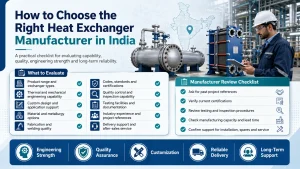
Selecting from numerous heat exchanger suppliers in India requires comparing technical capability before comparing price.
1. Define the Required Heat Duty
The manufacturer needs to know how much heat must be transferred.
Useful information includes:
- Hot-fluid inlet temperature
- Hot-fluid outlet temperature
- Cold-fluid inlet temperature
- Required cold-fluid outlet temperature
- Flow rates
The heat duty can then be calculated from the process data.
2. Provide Accurate Fluid Properties
Thermal design can require:
- Density
- Viscosity
- Specific heat
- Thermal conductivity
- Phase
- Composition
- Fouling tendency
Inaccurate process properties can lead to incorrect sizing.
3. Specify Operating and Design Pressure
Provide both:
- Normal operating pressure
- Design pressure
Also define allowable pressure drop on each side.
An exchanger can meet the required heat duty but still create process problems if pressure loss is too high.
4. Define Operating and Design Temperature
Temperature affects:
- Material strength
- Corrosion
- Thermal expansion
- Gasket selection
- Exchanger configuration
Both normal and upset conditions should be considered.
5. Select the Right Heat Exchanger Type
An experienced heat exchanger manufacturer in India should be able to evaluate whether the process is better suited to:
- Shell-and-tube
- Plate-and-frame
- Air-cooled
- Double-pipe
- Finned-tube
- Specialized exchanger technology
The lowest-cost configuration is not necessarily the lowest lifecycle-cost option.
6. Evaluate Thermal Design Capability
A technically capable industrial heat exchanger manufacturer should understand:
- Heat duty
- LMTD
- Overall heat-transfer coefficient
- Fouling factors
- Fluid velocity
- Tube layout
- Baffle arrangement
- Pressure drop
- Flow regime
- Phase change
- Thermal margin
Critical process equipment may also benefit from recognized thermal-analysis software.
7. Evaluate Mechanical Design Capability
Mechanical design should address:
- Shell thickness
- Tubesheet design
- Channels
- Flanges
- Nozzles
- Supports
- External loads
- Thermal expansion
- Differential pressure
- Tube vibration
Good thermal design does not compensate for poor mechanical engineering.
8. Check Material Selection Expertise
Possible materials include:
- Carbon steel
- Stainless steel
- Duplex
- Super duplex
- Copper alloys
- Nickel alloys
- Titanium
- Hastelloy
- Monel
The manufacturer should understand how corrosion, temperature and process chemistry affect material selection.
9. Verify Welding and Fabrication Capability
Evaluate:
- WPS
- PQR
- Welder qualifications
- Tube-to-tubesheet procedures
- Material traceability
- Fit-up controls
- Weld inspection
This is particularly important for a custom heat exchanger manufacturer handling pressure-containing equipment.
10. Review Inspection and Testing
Depending on the project, testing can include:
- Visual inspection
- Dimensional inspection
- Dye penetrant testing
- Magnetic-particle testing
- Ultrasonic testing
- Radiography
- PMI
- Hydrostatic testing
- Pneumatic testing
- Leak testing
Testing requirements should be specified during procurement.
11. Consider Cleaning and Maintenance Requirements
Ask whether:
- The tube bundle can be removed
- Tubes can be mechanically cleaned
- Plates can be accessed
- Tube plugging is possible
- Replacement gaskets are readily available
- Maintenance clearance is available around the equipment
Maintainability should be designed into the exchanger from the start.
Information to Send a Heat Exchanger Manufacturer for a Quotation
Hot-Side Process Data
Provide:
- Fluid name and composition
- Flow rate
- Inlet temperature
- Required outlet temperature
- Operating pressure
- Allowable pressure drop
- Physical properties
Cold-Side Process Data
Provide:
- Cooling/heating medium
- Flow rate
- Inlet temperature
- Required outlet temperature
- Operating pressure
- Allowable pressure drop
- Physical properties
Mechanical Design Requirements
Include:
- Design pressure
- Design temperature
- Material of construction
- Corrosion allowance
- Exchanger orientation
- Design code
- TEMA class where applicable
- Nozzle requirements
- Support requirements
Quality and Inspection Requirements
Specify:
- NDT
- Hydrotesting
- PMI
- Third-party inspection
- Material certificates
- Documentation
- Code stamping where applicable
Providing a complete process datasheet allows different heat exchanger suppliers in India to quote against the same technical basis.
Industries That Use Industrial Heat Exchangers
Oil and Gas
Applications include:
- Gas cooling
- Oil cooling
- Compressor cooling
- Heat recovery
- Condensation
- Process heating
Refineries
Refineries use large heat-exchanger networks for:
- Feed preheating
- Product cooling
- Condensation
- Reboiling
- Heat recovery
Petrochemicals
Petrochemical plants depend heavily on exchanger systems for controlling process temperatures and recovering thermal energy.
Chemical Processing
Common duties include:
- Reactor heating
- Reactor cooling
- Condensation
- Solvent recovery
- Product cooling
- Utility heat transfer
Fertilizers
Fertilizer facilities use exchangers in ammonia, urea and associated process and utility systems.
Pharmaceuticals
Applications can include:
- Purified water
- WFI
- Clean utilities
- Product heating
- Product cooling
- CIP/SIP systems
Food and Beverage
Heat exchangers are used for:
- Pasteurization
- Milk processing
- Beverage heating
- Product cooling
- Heat recovery
Plate and tubular heat exchangers are particularly common.
Power Generation
Applications include:
- Surface condensers
- Feedwater heaters
- Oil coolers
- Closed cooling systems
- Waste-heat recovery
HVAC and Utilities
Plate, shell-and-tube and air-cooled exchanger systems are widely used for:
- Chilled water
- Condenser water
- District cooling
- Refrigeration
- Industrial utilities
Common Heat Exchanger Problems
Fouling
Fouling deposits create an insulating layer on the heat-transfer surface.
This reduces thermal performance and can increase pressure drop.
Scale Formation
Mineral deposits from water can build up inside tubes or channels.
Scale significantly reduces heat transfer when allowed to accumulate.
Corrosion
Incorrect material selection can lead to:
- Pitting
- General corrosion
- Galvanic attack
- Stress-corrosion cracking
Tube Leakage
Tube failure can allow shell-side and tube-side fluids to mix.
This can contaminate process streams and force a shutdown.
Excessive Pressure Drop
Excessive fluid velocity, fouling or poor design can create higher-than-expected pressure loss.
Flow-Induced Vibration
High velocities can cause tubes to vibrate.
Over time, this may cause tube wear or fatigue.
Poor Fluid Distribution
Uneven distribution means some heat-transfer surfaces are underused while others carry excessive flow.
Incorrect Thermal Sizing
An undersized exchanger may never achieve the required outlet temperature even when mechanically sound.
How to Improve Heat Exchanger Efficiency
Heat-exchanger performance can often be improved by:
- Keeping heat-transfer surfaces clean
- Maintaining correct process flow rates
- Monitoring pressure drop
- Controlling fouling
- Repairing leaking tubes
- Maintaining utility temperatures
- Improving flow distribution
- Selecting appropriate materials
- Using heat recovery where practical
- Reviewing exchanger performance after process changes
A major process change should trigger a review of exchanger duty rather than assuming the original equipment remains adequately sized.
Questions to Ask Before Choosing a Heat Exchanger Supplier in India
Before issuing a purchase order, ask potential suppliers:
- Do you perform thermal design in-house?
- Which exchanger configuration do you recommend and why?
- What heat-transfer margin is included?
- Which fouling factors are being used?
- What is the calculated pressure drop?
- Which material is recommended?
- Which design code applies?
- Which TEMA class is proposed?
- What welding procedures will be used?
- What NDT is included?
- Is hydrotesting included?
- Can third-party inspection be arranged?
- Can the exchanger be manufactured according to our drawings?
- Can replacement tube bundles or parts be supplied?
- What documentation is included?
- What access is required for maintenance?
A technically strong response to these questions is often more valuable than simply receiving the lowest quotation.
Final Thoughts
India has a large and technically diverse base of heat exchanger manufacturers in India, ranging from compact plate-exchanger specialists to manufacturers capable of producing large refinery and petrochemical shell-and-tube equipment.
The most suitable supplier depends on far more than manufacturing capacity.
Industrial buyers should evaluate:
- Thermal engineering
- Mechanical engineering
- Exchanger configuration
- Materials
- Pressure and temperature capability
- Fouling behavior
- Welding quality
- Inspection
- Testing
- Maintainability
- Documentation
- Project experience
When comparing industrial heat exchanger manufacturers in India, use a common process datasheet and technical specification so that every quotation is based on the same design conditions.
For companies seeking a heat exchanger manufacturer India supplier that also provides wider industrial fabrication capabilities, National Engineers & Steel Fabricators is one company worth evaluating.
Established in Surat in 1990, NESF manufactures and fabricates heat-transfer and process equipment alongside pressure vessels, storage equipment, piping skids and custom heavy fabricated assemblies.
Its current process-equipment range includes heat exchanger shells and condensers, making the company particularly relevant where heat-transfer equipment needs to be coordinated with broader plant-fabrication requirements.
Whether the requirement is for a shell and tube heat exchanger manufacturer in India, plate heat exchanger manufacturer in India, air cooled heat exchanger manufacturer in India, stainless steel heat exchanger manufacturer, process heat exchanger manufacturer, condenser manufacturer in India, oil cooler manufacturer in India, custom heat exchanger manufacturer, TEMA heat exchanger manufacturer India supplier or ASME heat exchanger manufacturer India supplier, the final selection should be based on verified engineering capability and suitability for the actual process.
Looking for a Custom Industrial Heat Exchanger?
National Engineers & Steel Fabricators supports custom industrial process-equipment and heat-transfer fabrication requirements from its Surat, Gujarat facility.
For a useful technical discussion or quotation, share:
- Heat exchanger type
- Hot and cold fluid details
- Flow rates
- Inlet and outlet temperatures
- Operating pressure
- Design pressure
- Design temperature
- Allowable pressure drop
- Material of construction
- Required design code
- Drawings or process datasheet
- Inspection and testing requirements
- Delivery location
National Engineers & Steel Fabricators
Sachin GIDC, Surat, Gujarat, India
Heat Exchanger Fabrication | Pressure Vessels | Process Equipment | Custom Industrial Fabrication
NESF’s current enquiry process asks buyers to provide equipment type, material of construction, pressure/temperature, specifications or drawings and project requirements so its technical team can review the fabrication scope.
Frequently Asked Questions About Heat Exchanger Manufacturers in India
Which company manufactures custom heat exchangers in India?
Several manufacturers provide custom industrial equipment.
National Engineers & Steel Fabricators supports heat exchanger shells, condensers and process-equipment fabrication based on project specifications, drawings and duty conditions.
When evaluating a custom heat exchanger manufacturer, buyers should verify both thermal-engineering and fabrication scope rather than customization of dimensions alone.
What is the most common industrial heat exchanger?
Shell-and-tube exchangers are among the most widely used heat exchangers in refineries, petrochemical plants, chemical facilities, fertilizer plants and other heavy process industries.
Their major advantage is engineering flexibility across a broad range of temperatures, pressures, materials and process conditions.
What is the difference between a heat exchanger and a condenser?
A heat exchanger is any equipment designed to transfer thermal energy between fluids.
A condenser is a particular type of heat exchanger that removes heat from a vapour so that the vapour changes into a liquid.
Which heat exchanger is most efficient?
There is no universally most-efficient design.
Plate heat exchangers often offer very high heat-transfer performance per unit of equipment volume, while shell-and-tube exchangers offer greater flexibility for many high-pressure, high-temperature and fouling services.
Efficiency must be evaluated for the actual application.
Which heat exchanger is suitable for high-pressure applications?
Shell-and-tube and specialized exchanger designs are commonly used for high-pressure applications.
Mechanical design, material, wall thickness, tubesheet construction and applicable pressure code must be evaluated for the specific service.
What materials are used in industrial heat exchangers?
Common materials include:
- Carbon steel
- SS304/304L
- SS316/316L
- Duplex
- Super duplex
- Copper alloys
- Nickel alloys
- Titanium
- Hastelloy
- Monel
The correct material depends on corrosion, temperature, pressure and process chemistry.
What is a TEMA heat exchanger?
A TEMA heat exchanger generally refers to a shell-and-tube exchanger designed using relevant Tubular Exchanger Manufacturers Association mechanical standards.
TEMA provides guidelines covering exchanger configurations, construction and mechanical requirements.
What information is required to design a heat exchanger?
A manufacturer typically needs:
- Fluid details
- Flow rates
- Inlet temperatures
- Required outlet temperatures
- Operating pressures
- Allowable pressure drops
- Physical properties
- Fouling factors
- Materials
- Design pressure
- Design temperature
More complete process data generally produces more reliable thermal sizing.
Can heat exchangers be manufactured according to client drawings?
Yes.
A capable heat exchanger fabrication company can fabricate equipment according to approved drawings, datasheets and specifications.
However, buyers should clearly define whether the manufacturer is only performing build-to-print fabrication or also taking responsibility for thermal and mechanical design.
How do I choose between plate and shell-and-tube heat exchangers?
Consider:
- Operating pressure
- Temperature
- Fluid cleanliness
- Fouling
- Available space
- Required heat duty
- Maintenance
- Material compatibility
- Pressure drop
- Capital and lifecycle cost
What causes heat exchanger fouling?
Common causes include:
- Mineral scale
- Suspended solids
- Biological growth
- Chemical deposits
- Coking
- Corrosion products
Correct velocity and exchanger configuration can help reduce fouling, but periodic cleaning may still be required.
Can heat exchangers recover waste heat?
Yes.
Heat recovery is one of the most valuable applications of industrial heat exchangers.
Heat from a hot process stream can be transferred to another stream that requires heating, reducing external utility consumption.
Which industries use stainless steel heat exchangers?
Stainless-steel exchangers are frequently used in:
- Pharmaceuticals
- Food processing
- Dairy
- Beverages
- Chemicals
- Water treatment
- Specialty process industries
The exact stainless-steel grade should be selected according to corrosion and hygiene requirements.
What is an air-cooled heat exchanger?
An air-cooled heat exchanger transfers heat from process fluid to ambient air.
Fans pass air across finned tubes, eliminating or reducing the need for cooling water.
They are widely used in refineries, petrochemical facilities, power generation and water-scarce locations.
Where can I find an oil cooler manufacturer in India?
Several Indian heat-transfer equipment manufacturers provide oil coolers, including companies that specialize in shell-and-tube and finned-tube systems.
Uniheat, for example, currently lists hydraulic oil coolers, lube-oil coolers and shell-and-tube oil coolers among its products.
Selection should be based on oil flow, viscosity, temperature, cooling medium and allowable pressure drop.
What should I look for in an ASME heat exchanger manufacturer in India?
Where ASME construction is required, verify:
- Current ASME authorization applicable to the project
- Qualified welding procedures
- Welder qualification
- Material traceability
- NDT capability
- Hydrotesting
- Authorized inspection
- Manufacturer's documentation
Do not rely only on the phrase "ASME standard" in marketing material.